

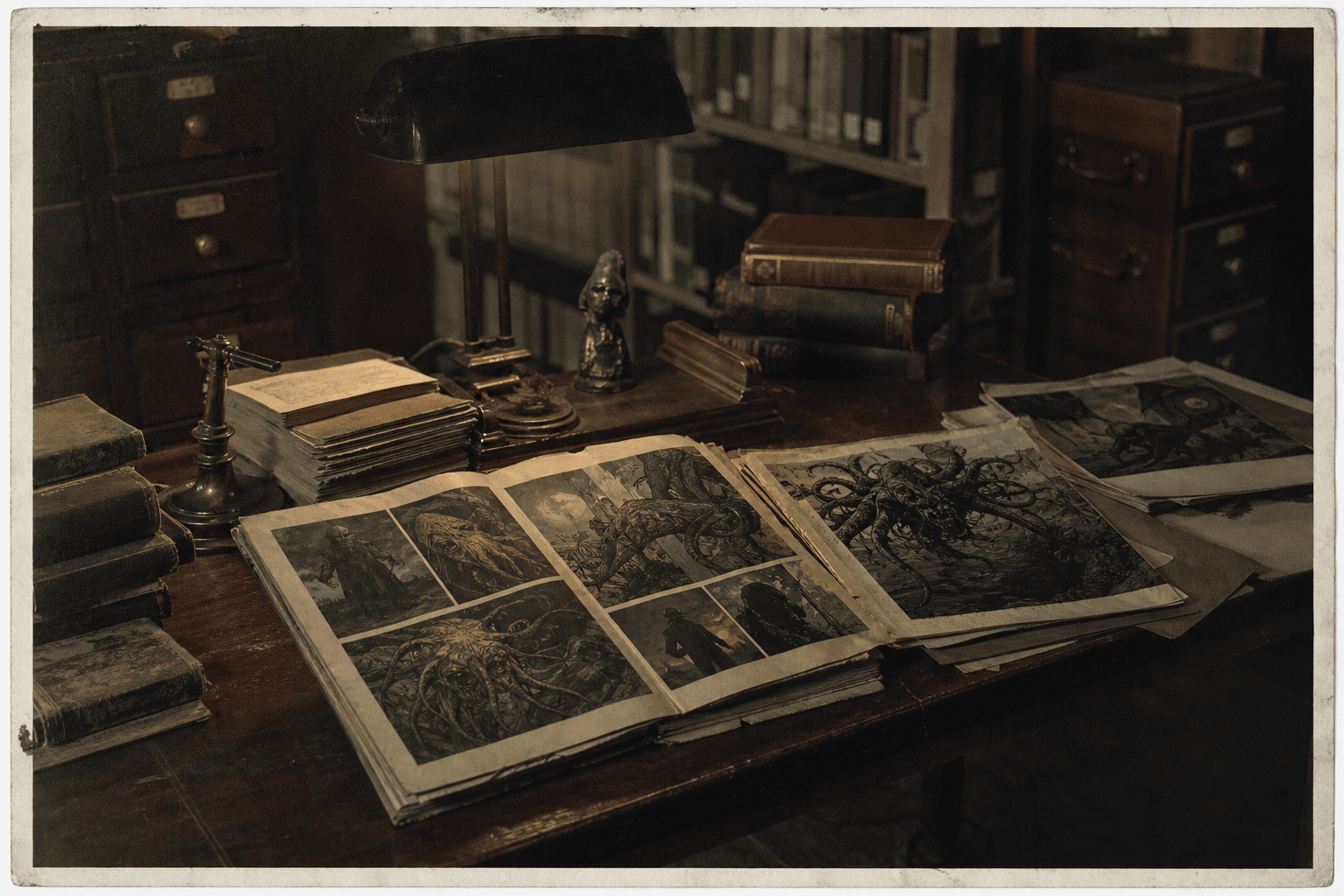
Field Dispatch
Lovecraft Comics & Graphic Novels
Illustrated field manuals - graphic narrative division.
Alan Moore & Providence
Alan Moore and Jacen Burrows’s Providence is not a straight Lovecraft comic adaptation - it is metafictional excavation of his life, circle, and stories, rewarding readers who already know pulp history and sexual subtext debates. Treat it as graduate seminar in comics form: dense, explicit, occasionally confrontational about Lovecraft’s prejudices and narrative masks. Providence comic readers should expect cameos, recombinations, and irony - not a gentle intro to Cthulhu memes.
Alan Moore & Providence: prerequisites and payoffs
Complete core fiction first - at minimum Call of Cthulhu, Shadow over Innsmouth, and one Dream Cycle touchstone - then visit /cthulhu-mythos for entity routing. Moore rewards recognition of Randolph Carter echoes, bookshop appearances, and historical figures from the Lovecraft literary circle (/journal/lovecraft-literary-circle). Without prerequisites, Providence reads as unpleasant puzzle; with them, it is commentary you can argue with chapter by chapter.
Themes Moore amplifies: books, bodies, and biography
Providence lingers on forbidden books, publishing economies, and bodies as sites of horror - aligned with Lovecraft yet modernized in comics grammar. Burrows’s art is clinically explicit where Lovecraft euphemized; that contrast is pedagogical if faciliated carefully. Teachers should issue content warnings and historical context on racism and sexual violence threads - not to cancel study, but to study ethically.
How Providence relates to archive slugs
When Moore riffs The Shadow over Innsmouth, anchor discussion in /archive/the-shadow-over-innsmouth. When Pickman-adjacent art appears, use /archive/pickmans-model. Moore invents bridges; archive records keep primary plot boundaries clear. Debate Moore’s choices as criticism, not as retcon to wikis.
After Providence: where readers go
Graduates of Moore should read /journal/lovecraft-biography and /journal/lovecraft-letters for historical ballast, then Culbard for cleaner adaptations. If Moore’s density exhausts, try Tanabe manga (/journal/gou-tanabe-lovecraft-manga) for visual pacing without metafictional overload. Providence proves comics can think about Lovecraft; it does not replace reading Lovecraft. Book clubs should schedule Providence reading across months with content agreements and breakout rooms for readers who need to skip explicit issues - pace prevents shock-only engagement.
Reread cycles and annotation discipline
Providence rereads reward pulp history notes - keep a timeline of which real stories echo in which issues. Avoid annotating library copies with explicit content; buy your own volume. Debate Moore in private groups before public forums; spoilers harm newcomers. When Moore’s sexual content dominates discussion, redirect to Lovecraft’s own subtext debates in /journal/supernatural-horror-in-literature.
Ian Culbard line
Ian Culbard’s SelfMadeHero line offers accessible, clean Lovecraft graphic novels - major tales adapted with line art and pacing that favor clarity over Moore’s density. Good for classrooms bridging prose to manga, Culbard compresses lectures and exposition with discipline; note what moved when teaching comic adaptation craft. Compare Culbard panels to Gou Tanabe on the same story to see Western versus Japanese compositional choices - widespread layouts versus cinematic ink.
Culbard adaptations: clarity, pace, and teaching
Volumes covering At the Mountains of Madness, The Shadow over Innsmouth, and The Case of Charles Dexter Ward map to archive slugs /archive/at-the-mountains-of-madness, /archive/the-shadow-over-innsmouth, and Ward’s record. Students should read one Culbard chapter, one prose chapter, then list three details only prose provides - adjective rhythm, legalistic tone, nested doubt. That assignment teaches medium without ranking supremacy.
Compression choices writers should study
Culbard cuts to survive page count - identify expository dialogue removed and decide whether loss matters. Sometimes compression improves pace; sometimes it flattens cosmic horror into plot beats. Debate in class using /journal/complete-lovecraft-reading-order as context for where stories sit in career arc.
Culbard versus Baranger versus Tanabe
Culbard is line narrative; Baranger is painterly plate (/journal/francois-baranger-illustrated-lovecraft); Tanabe is manga ink. Assign one scene three ways if budget allows - triangulation teaches adaptation more than any lecture. Entity homework still routes to /cthulhu-mythos.
Reader path after Culbard
Move from Culbard to prose deep cuts - The Thing on the Doorstep, The Dreams in the Witch House - then to /journal/junji-ito-lovecraft for non-Lovecraft manga kinship. Culbard builds confidence; confidence should return you to sentences, not replace them.
Library holdings and classroom sets
SelfMadeHero volumes often appear in library graphic novel sections - place holds early for semester starts. Classroom sets should include one prose copy per Culbard volume to compare compression. Assign students to mark one omitted paragraph and defend whether omission helped pacing - teaches comic adaptation ethics without purity tests.
Culbard as bridge to Tanabe and Baranger
After Culbard, assign one Tanabe volume on the same story, then one Baranger plate study - triangulation teaches global Lovecraft art without declaring winners. Students write one page on which medium preserved ambiguity best; prose usually wins if they are honest.
Breccia & international
Alberto Breccia’s Argentine Lovecraft comics - including interpretations of The Dunwich Horror and The Nameless City - bring expressionist ink and political allegory alien to American pulp literalism. International comics prove the mythos is a translation-friendly horror engine: bureaucracy, family, and land wear local masks. Breccia’s lines feel carved, not traced; shadows carry ideology, not just mood.
Breccia & international: further reading paths
Seek English collections when available; untranslated editions still circulate in art-book contexts - library interloan helps researchers. Pair Breccia with Junji Ito (/journal/junji-ito-lovecraft) for non-Anglophone visual language surveys. Pair with /journal/modern-lovecraftian-horror for living prose successors outside comics.
Political allegory and mythos machinery
Breccia uses cosmic horror comics to comment on power, not only monsters - readers trained on tentacle stickers may miss the point. Teach Breccia after students know Dunwich and Nameless City prose - /archive/the-dunwich-horror, /archive/the-nameless-city - so allegory has anchor text.
International canon hygiene
Do not treat Argentine or Japanese visual interpretations as “more authentic” than New England prose - they are dialogues. Cite archive for plot, cite art for interpretation. Avoid scanlation when official translations exist.
Comics globe-trot ending in fiction
Finish international tours by rereading Lovecraft with new eyes - notice how export transforms him. Route games and film next: /journal/eldritch-horror-board-game-and-mythos, /journal/lovecraft-on-screen. Comics worldwide show one truth: weird fiction travels; readers must still return to primary words at /cthulhu-mythos.
Translation, colonial gaze, and local horror
International Lovecraft comics refract imperial anxieties through local histories - teach Breccia with Argentine context, not as generic “weird panels.” Compare Breccia’s bureaucratic shadows to Culbard’s clarity and Tanabe’s architectural stillness. Seek translator interviews when available; lettering choices alter tone. Avoid treating non-English art as exotic garnish - cite artists by name, credit publishers, buy official translations when they exist.
Archival research and special collections
University libraries sometimes hold Breccia exhibition catalogs - request special collections appointments for plate study. Photograph only if policy allows; otherwise sketch compositions. Link research essays to archive slugs for plot anchors, not for replacing primary reading. Comics research without prose foundation produces stylish ignorance - pair every plate with a paragraph you read aloud from Joshi or Wikisource per /journal/read-lovecraft-online.
Breccia workshop prompts for advanced seminars
Assign Breccia close reading prompts: identify three panels where ink weight replaces dialogue, then find a Lovecraft paragraph that achieves the same effect with adjectives. Seminars that skip prose produce artists who can mimic mood without understanding structure - do not skip prose.
Moore, Culbard, Breccia as a three-week unit
Week one: Moore Providence excerpt with warnings; week two: Culbard clarity; week three: Breccia allegory - students write a final essay on adaptation ethics citing archive slugs. This unit belongs after core fiction, not before.
Retail displays and anthology hunting
Browse Lovecraft comics anthologies for Breccia reprints and international shorts - anthologies introduce artists cheaper than chasing OOP singles. Note publication year and translation credit on the copyright page before teaching. Anthologies also help students see that Lovecraft comics are a global tradition, not an American-only pipeline. End the unit with a student-chosen panel and a defended archive slug - practice beats passive consumption.
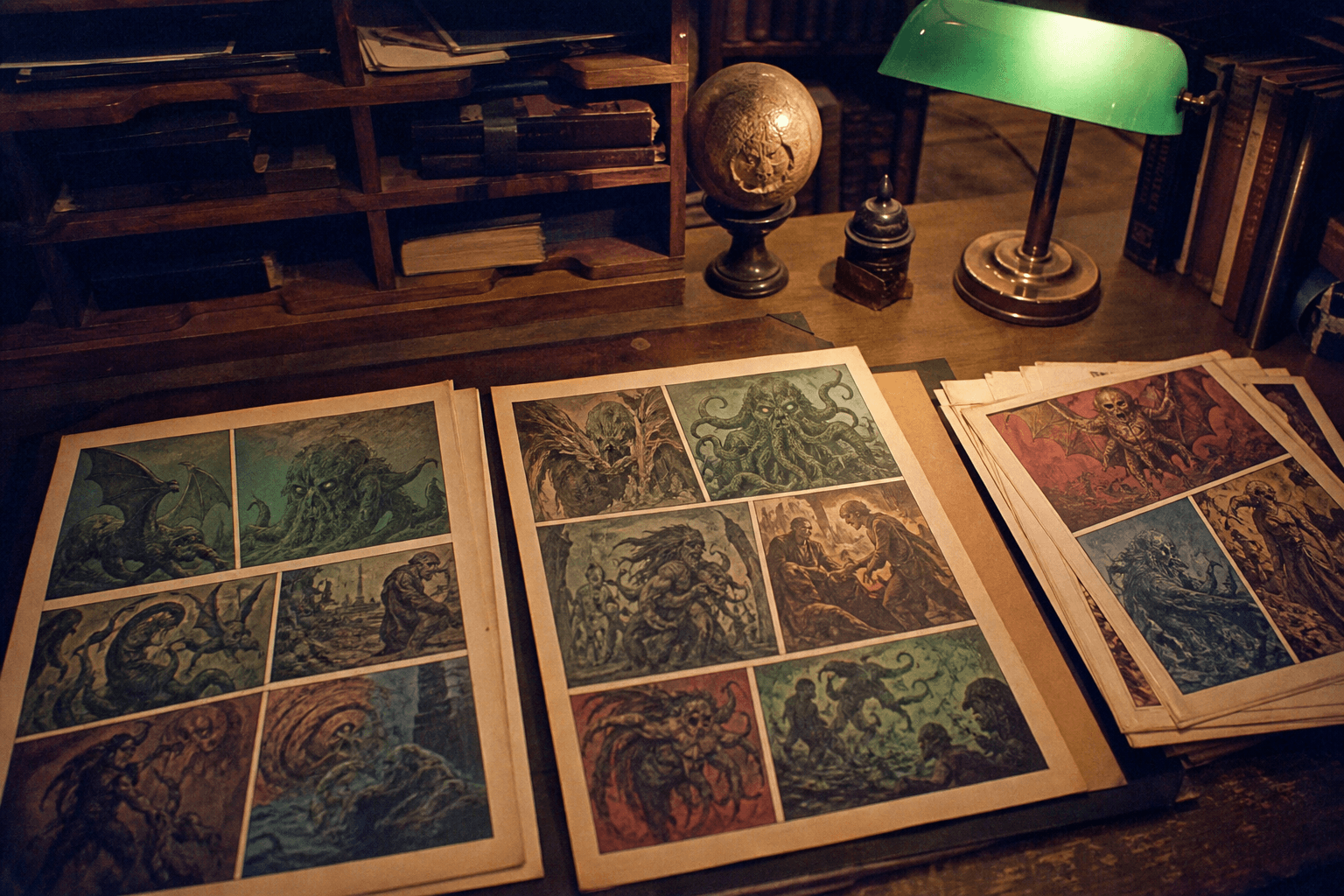
Evidence 01
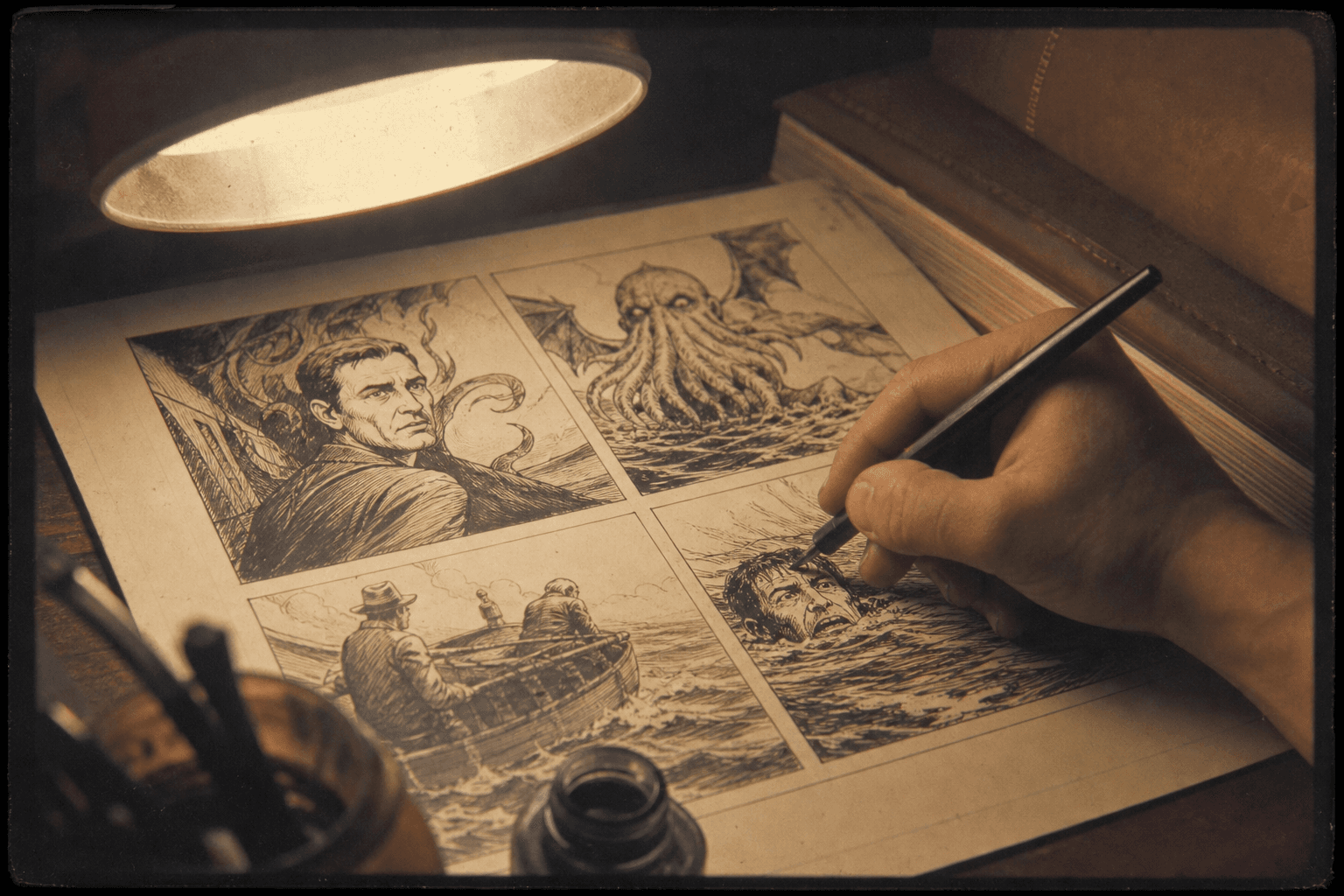
Evidence 02
Dispatch LOVECRAFT_COMICS_AND_GRAPHIC_NOVELS · Primary keyword: alan moore lovecraft
Continue reading

Field Dispatch
Gou Tanabe's Lovecraft Manga Adaptations
Complete guide to Gou Tanabe's manga adaptations of At the Mountains of Madness, The Shadow over Innsmouth, The Call of Cthulhu, and more.
Read dispatch →
Field Dispatch
Junji Ito & Lovecraftian Horror
How Junji Ito's manga engages Lovecraftian cosmic dread and body horror - with recommended starting points for new readers.
Read dispatch →