

Field Dispatch
Lovecraft's Literary Circle & Influences
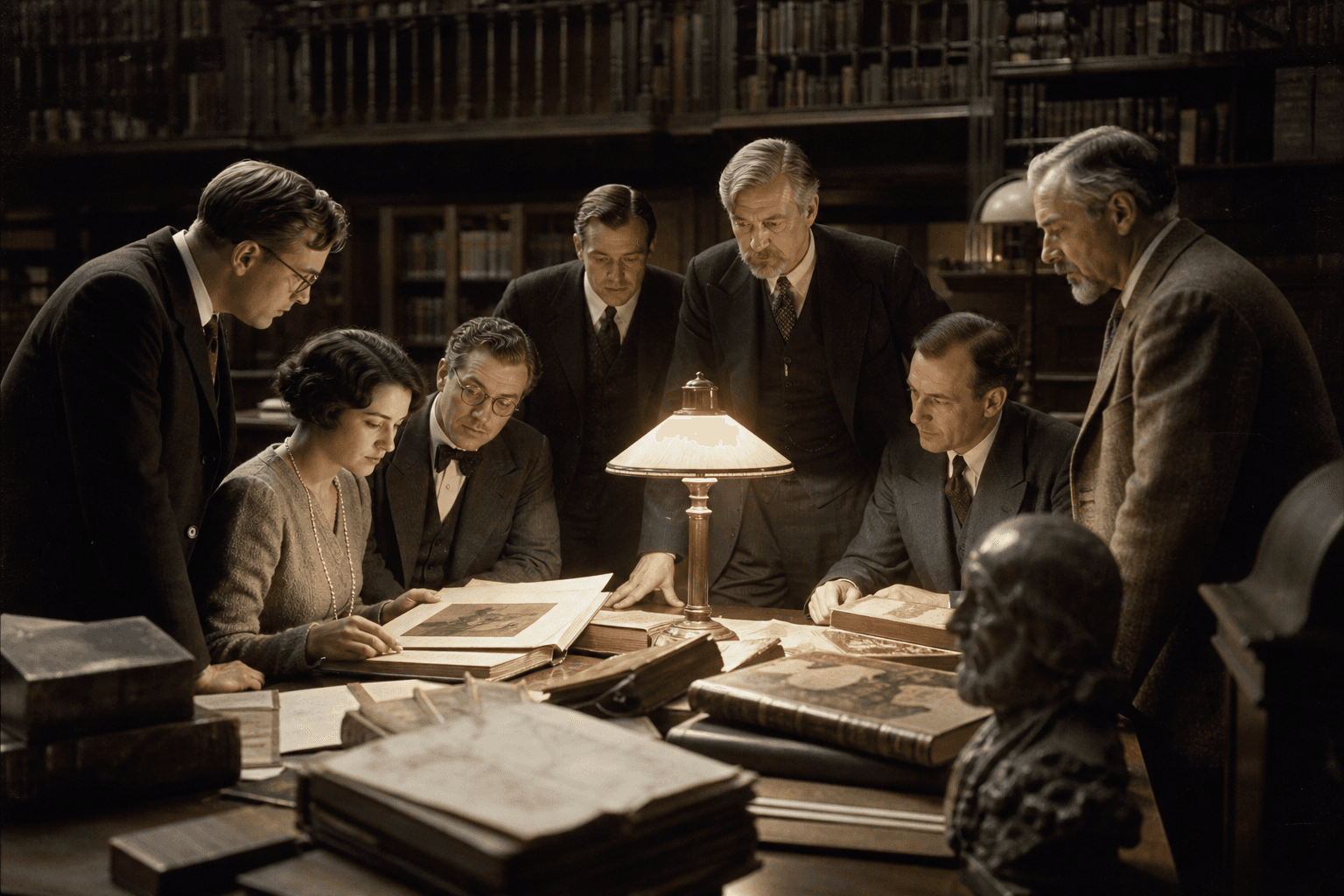
Correspondence network map - who exchanged forbidden knowledge.
Poe & the American gothic
Poe, the American gothic, and inherited interiors
Edgar Allan Poe is the first major landmark in Lovecraft's literary circle, even though the two men never shared a century. Lovecraft read Poe as master of unity, atmosphere, and psychological compression. The early tales show the apprenticeship openly: buried houses, ancestral crimes, narrators whose refinement cannot protect them from collapse. The Tomb and The Alchemist wear Poe's coat almost too neatly, but the later work keeps the architecture while moving the terror from guilty rooms to indifferent cosmos. The line from Poe to Lovecraft is therefore not simple imitation. It is a change in scale.
Poe's interiors taught Lovecraft how a setting could become a mind under pressure. In The Fall of the House of Usher, masonry, family, illness, and art converge until the house seems to think. Lovecraft adapts that method when Arkham /archive/arkham, Innsmouth /archive/innsmouth, or the blasted farms around The Colour Out of Space /archive/the-colour-out-of-space begin behaving like evidence. His narrators still inherit Poe's nervous eloquence, but their discoveries point beyond family guilt toward deep time, alien biology, or forbidden scholarship. Supernatural Horror in Literature makes this lineage explicit, praising Poe as a technical liberator of American fear.
From chamber horror to cosmic exposure
The useful comparison is not Poe versus Lovecraft but Poe through Lovecraft. Poe gives the chamber; Lovecraft opens a trapdoor beneath it. Poe gives the doomed aesthete; Lovecraft gives the professor whose education becomes a liability. Readers who begin with Biography can hear how Lovecraft's personal antiquarianism fastened itself to Poe's formal lessons. Readers who continue to Modern Lovecraftian Horror will find contemporary writers still using the same inherited interior, then contesting who was locked outside it.
For archive cross-reading, place Pickman's Model /archive/pickmans-model beside Poe's art-and-madness tales, then read The Outsider /archive/the-outsider as the moment when the chamber wall becomes a mirror. Poe remains the old house at the edge of the survey, still standing, still damp, and still teaching later horrors how to breathe indoors before the roof opens onto stars that do not know our names.
Dunsany & dream prose
Dunsany, dream geography, and ceremonial wonder
Lord Dunsany gave Lovecraft permission to dream without apologizing for dream logic. Before the Cthulhu Mythos became the dominant public label, Lovecraft wrote tales where cities, gods, cats, kings, and impossible stairways move with the grace of invented myth. Dunsany's influence is clearest in the Dream Cycle, where prose becomes ceremonial and geography behaves like memory. The Cats of Ulthar /archive/the-cats-of-ulthar is brief, polished, and merciless in fairy-tale fashion; The Dream-Quest of Unknown Kadath /archive/the-dream-quest-of-unknown-kadath stretches that mood into a pilgrimage across perilous marvels.
Dunsany matters for Lovecraft influences because he widened the emotional palette. Poe taught claustrophobia; Dunsany taught distance, melancholy, and strange pageantry. In the dream tales, terror is often braided with longing. Randolph Carter does not merely fear the unknown; he wants the lost city, the sunset terrace, the impossible view. That desire changes the field conditions. A monster in Dunsany's shadow is not only a threat but a gatekeeper between ordinary life and a more dangerous beauty. The poetry dispatch shows how cadence and invented names trained effects later mistaken for pure prose habit.
Dream prose as training for mythic names
Read this material beside Gou Tanabe and Junji Ito, because artists often notice the visual richness before the plot machinery. Dunsany's gift to Lovecraft was not a pantheon to copy but a confidence that invented names could feel ancient if the cadence was right. Even Cthulhu /archive/cthulhu benefits from that lesson: a name can arrive before explanation and still command the room. Even Nyarlathotep /archive/nyarlathotep can walk onstage as rumor before doctrine.
The Literary Circle dispatch uses Dunsany as a reminder that Lovecraft was never only the prophet of black seas and dead stars. He was also a reader of jeweled cities, talking cats, and dreams that cut deeper because they were beautiful. Cross-link Supernatural Horror in Literature when teaching how Lovecraft's critical praise for wonder differs from his later cosmic chill.
The pulp circle
The Weird Tales circle and reciprocal contagion
The Weird Tales circle turned private obsession into correspondence, competition, and cross-pollination. Clark Ashton Smith brought decadent color and sculptural vastness; Robert E. Howard brought velocity, violence, and mythic history; Frank Belknap Long brought urban menace and friendship close enough to sting. Lovecraft did not sit above these writers as a solitary master handing down tablets. He argued, borrowed, revised, praised, scolded, and learned. The letters show a workshop scattered across mail routes, with stories and opinions moving faster than publication schedules.
This matters because the so-called Mythos was social before it was canonical. Friends planted names in one another's stories, treated the Necronomicon /archive/necronomicon as a shared false book, and converted private jokes into apparently ancient evidence. Smith's exotic worlds and Howard's historical cycles are not footnotes to Lovecraft; they are parallel laboratories. When Howard's vigor presses against Lovecraft's cosmic pessimism, the reader can hear two theories of terror colliding: one in which action still matters, another in which action often reveals how small the actor is. Selected Letters preserves the temperature of those disputes.
Contagion without a single owner
The network also complicates ownership. Later readers may search for one official Cthulhu Mythos map, but the pulp record is messier and more alive. Derleth, Smith, Long, Howard, C. L. Moore, and others made weird fiction a field rather than a monument. Their exchanges help explain why The Whisperer in Darkness /archive/the-whisperer-in-darkness feels like science-fiction rumor while The Shadow over Innsmouth /archive/the-shadow-over-innsmouth tightens into coastal investigation. The writers were watching markets, reading each other, and testing what a forbidden name could do when dropped into a new landscape.
Contagion is the right metaphor, but not because the ideas were diseased. They spread because the circle kept touching the same cursed instruments. For modern continuation, read Modern Lovecraftian Horror and Eldritch Horror to see how games and novels inherit the social mythos while simplifying it for play. The original circle was never a franchise bible. It was a correspondence network with teeth.
Derleth & mythos expansion
Derleth, preservation, and the problem of system
August Derleth is the unavoidable contested witness in any account of Lovecraft's legacy. Without Derleth and Arkham House, much of the fiction might have remained hard to find, trapped in brittle magazines and private memory. He helped preserve, publish, and promote Lovecraft when the broader literary world was not waiting at the door. That debt is real. So is the problem: Derleth's interpretation systematized the material, popularized the phrase Cthulhu Mythos, and sometimes recast Lovecraft's cosmic indifference as a more conventional struggle among elemental powers.
The field reader should mark the distinction carefully. Lovecraft's own stories rarely behave like a tidy occult taxonomy. Cthulhu /archive/cthulhu, Yog-Sothoth /archive/yog-sothoth, Nyarlathotep /archive/nyarlathotep, and the Great Old Ones are not arranged with the clarity of a bestiary written before the fiction. Their power lies partly in broken evidence: cult testimony, damaged books, dreams, and academic speculation. Necronomicon Books Guide and Eldritch Horror both inherit parts of this later sorting impulse, especially where games need rules that stories never supplied.
Publisher, fan, and interpreter at once
Derleth should not be treated only as villain or savior. He is a publisher, fan, writer, organizer, and interpreter whose decisions built the road most readers still travel. A serious Literary Circle dispatch can thank him for the road while warning about the signs he posted along it. Compare Derleth's framework with Supernatural Horror in Literature, where Lovecraft's own theory prizes atmosphere and cosmic awe over doctrinal clarity. Then return to Complete Reading Order and read the primary tales in sequence.
The fog lifts in some places and thickens in others, which is exactly where the original fiction often wants the reader to stand. Pair Derleth's afterlife with Biography to see how friendship, not literary fame, first saved the shelf. The mythos was never pure. It was rescued, packaged, argued over, and only later mistaken for a single author's blueprint.
Evidence 01

Evidence 02
Dispatch LOVECRAFT_LITERARY_CIRCLE · Primary keyword: edgar allan poe lovecraft
Primary sources

Continue reading
Field Dispatch
H. P. Lovecraft - Biography
Howard Phillips Lovecraft's life: Providence, Weird Tales, marriage to Sonia Greene, literary friendships, and the worldview behind cosmic horror.
Read dispatch →
Field Dispatch
Houellebecq on Lovecraft - Against the World, Against Life
Michel Houellebecq's book on H. P. Lovecraft - arguments, controversy, and why it matters for understanding cosmic horror.
Read dispatch →